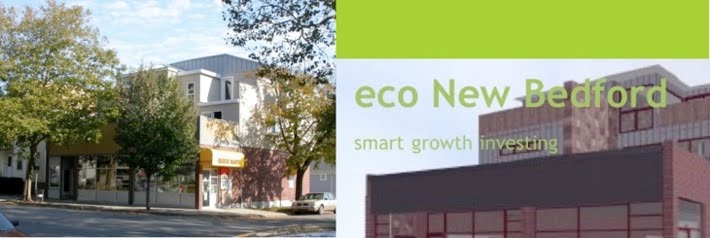
Showing posts with label New Bedford Economic Development Council. Show all posts

Thursday, March 3, 2011

Revival of the Mom and Pop !

The center store has been developed for a limited food service - such as gourmet coffee and ice cream plus soups and salads - see previous posting.
Throughout construction of the townhouses two commercial spaces remained vacant but always active with construction. Materials were worked on here and stored here. Even though we would have moved out for an incoming business, the unfinished shell was unable to attract potential business.

A strategy developed, though, to prep the space with intentions to make it more turnkey for the opening of a new business. An approach described as Frugal Design is being used to make this space uniquely appealing and satisfying. Getting past the many hurdles of constructing a new space is not for every new business owner. With this space available and assistance from NBEDC, it is just a matter of time to attract a determined and creative entrepreneur.

Contact Us if you have an interest in this business opportunity or would like design assistance in developing a property. Professional design skills are essential to getting the most out of a property investment.

Wednesday, July 22, 2009

Take a Look


The New Bedford Economic Development Council has posted the brochure for the South End on its homepage. The brochure is part of a collection promoting the commercial opportunities of New Bedford neighborhoods. The demographic information included by the NBEDC is worth checking out.
Also see earlier posts "Mixed Use Prospects" and "What's Taking Shape"

Wednesday, January 7, 2009

First thoughts of a student on the site


My name is Thalia Lewis, and I’m the newest team member working with Carol and Tony of effortlessdesign on the eco New Bedford/ Smart Growth on Brock Ave. project. I’m a Masters student at Boston Architectural College, and this is my first internship position in the field. I became involved in the New Bedford project (which has spanned several years) just three weeks ago, so I am climbing a steep and snowy learning curve in order to understand the ins-and-outs of this project. So far, so good. The project is incredibly exciting and unquestionably has the potential to have a profound impact on the New Bedford community. What I don’t know about Smart Growth and community building could fill volumes, but my effort as co-blogger will be to share my on-the-job learning as a participant in the project, hopefully providing some insight for others like me, who are invested in smart, sustainable community development and want become more involved and better informed.

For my first post, Carol asked me to share a bit about what I’ve learned in my initial weeks working on the project. That too, could fill volumes, but I’ll spare you the part about how I should have worn an extra set of long-johns my first day on the site (oy!).

It takes a village...
In just these few weeks, I’ve learned a fair amount about the New Bedford community: its architectural and cultural fabric, its economic triumphs and struggles. I’ve learned about the principles of Smart Growth, and how projects like Smart Growth on Brock Ave. have the potential to radically and rapidly revitalize a community like New Bedford, architecturally and economically. New Bedford already has in place the foundations of what a community needs to flourish economically in an environmentally sustainable way: limited sprawl, walkable neighborhoods, a core of thriving small businesses, a mass-transit connection to the major urban centers.


Most importantly, however, I’ve learned that in much the same way as “it takes a village to raise a child,” it takes a community to re-build a community. Large corporations may provide a certain kind of stimulus to a nation’s economy, but there is tremendous potential at the local level for a community like New Bedford to revitalize its own economy through small business and local investment. This understanding, alongside the notion that community development can be done in a way that is ecologically as well as economically sustainable, is at the heart of the eco New Bedford project.

The local architect has a major role to play in the re-building of a community. We are not simply designers: we are developers, planners, and master builders (as well as advocates, strategists, negotiators, politicians, publicists...). But for small-scale projects Smart Growth on Brock Ave. to have a big impact on the community, the full resources of the community must be mobilized: local architects, local contractors and suppliers, local politicians, local development agencies like the New Bedford Economic Development Council, home-grown advocacy groups like the Buzzard’s Bay Coalition, and equally, local residents (the entrepreneur, the home owner, as well as the neighbourhood kid who shovels the site when it snows). There are many roles to be played. It’s for each of us to decide what our individual role will be in the “smart” process of re-building New Bedford, and communities like it across the nation. My role, for now, is “a student on the site.”

My first day on the Brock Ave. site. Observing the installation of SIPs on the residential units. A highly educational day, which could only have been improved by wearing long-johns. For more information on SIPs, see the Dec. 27, 2008 post: SIPs - Installing Structural Insulated Panels.


Monday, December 29, 2008

Sustainable Living Template

In collaborating with effortlessdesign I am fascinated by the number of interconnections and overlap of common goals between sustainable community development and sustainable buildings. The mind-map below illustrates how design choices that strengthen the community are also good choices for our environment.

effortlessdesign is working to implement the planning objectives of the Coalition for Buzzards Bay (www.savebuzzardsbay.org) and the New Bedford Economic Development Council (www.nbedc.org), and they look forward to future collaborations of strengthening the community with a range of local organizations. Think globally, act locally, and decide to prosper in the New Year!


effortlessdesign is striving to strengthen the Brock Ave neighborhood while practicing green planning principles. Green construction techniques have been implemented, and thinking on a regional scale means that this urban-infill project makes use of mass transit and increases density in an exiting neighborhood with existing infrastructure. Mixed-use planning expands housing stock and improves the quality of commercial space available on Brock Avenue.

Fresh property development revitalizes the community.  This section of New Bedford has solid traditional housing stock. The spacious, modern residential units being added above the existing commercial spaces offer a new alternative choice in the charming neighborhood. This project is more than an average infill project, it has the potential to put this block of Brock Ave on the map. New Bedford natives who know what their city offers after living in New York, Providence or Boston will appreciate the edgy design of the residential condos that lend flare and sex appeal to living here.

On one hand this project embodies a humble ambition to strengthen an existing building in a neighborhood that is still up and coming, and yet it creates high design for the rest of us. Making good design accessible to everyone is a core value for effortlessdesign where they use opportunity and efficiency as their guides. 

Here at Brock Ave, Carol Fisher and Antonio Pina have not only made good design accessible in a modest community, they have chosen to invest in New Bedford and source building materials from local suppliers to strengthen community and keep revenue in the community.  They kept the Quick Mart open to the neighborhood during construction. effortlessdesign is committed to the growth and development of New Bedford and approaches the Brock Avenue project as a model for other SmartGrowth projects in New Bedford. 

The new commercial spaces will become a center for the local community and your suggestions for types of tenants for the commercial spaces will help in starting new business. Please vote on the side bar!

Sunday, December 14, 2008

Project Background


The South New Bedford neighborhood is a unique urban environment with expansive views, ample recreation, a vibrant diverse population, and mild temperatures. As the area waits for the commuter train to activate service (tracks & facilities are in place), it remains unrecognized as a beachfront village with friendly bungalows and well-kept triple deckers.

Our project on Brock Avenue is testing a number of concepts namely the creation of a neighborhood “hot spot” that improves the economic prospects of small business located there, and funding the rehab of a deteriorated commercial building with the development of two efficient yet spirited residences above.

It is our experience that developing older buildings can bolster the local economy providing good jobs to people not drawn to more professional sectors. We believe that developing construction skills and craft keeps an important knowledge base alive. Since 2001 we have consistently invested in our employees training them in range of construction techniques. Renovating buildings creates wealth, and design/planning is critical in achieving that possibility.

Our demonstration project involves current Urban Redevelopment design values known as Smart Growth. The site is located on a bus route to downtown, with an oceanfront park across the street. The new residential component increases density at the neighborhood scale and re-invigorates an existing commercial block. Our interest in this project began when curating the Boston Architectural College’s Shelter & Beyond Exhibit. Infill of underutilized urban areas, particularly in a culturally and enviromentally rich community like New Bedford, is a desirable alternative to sprawl. With the promise of commuter rail to the south coast, we focused on commercial redevelopment with efficient housing.

During the rehabilitation phase all of the construction debris was sorted, and engineered wood products are used consistently throughout. The existing Quik Mart stayed open every single day during construction. Construction of the second phase meets the requirements of LEED certification. Structural Insulated Panels with an Insulated Exterior Finishing System (EIFS) completely stops air infiltration and provides a building envelope 10% more efficient than required by the current Massachusetts energy code. Shear wall design and coastal windows meet the 110 mph wind speed. Domestic hot water will be provided using solar panels, and energy efficient lighting, heating and cooling are planned.

Clearly there is a lot happening on Brock Avenue, and the goal of this blog is to provide more details to the background description given in this first entry.